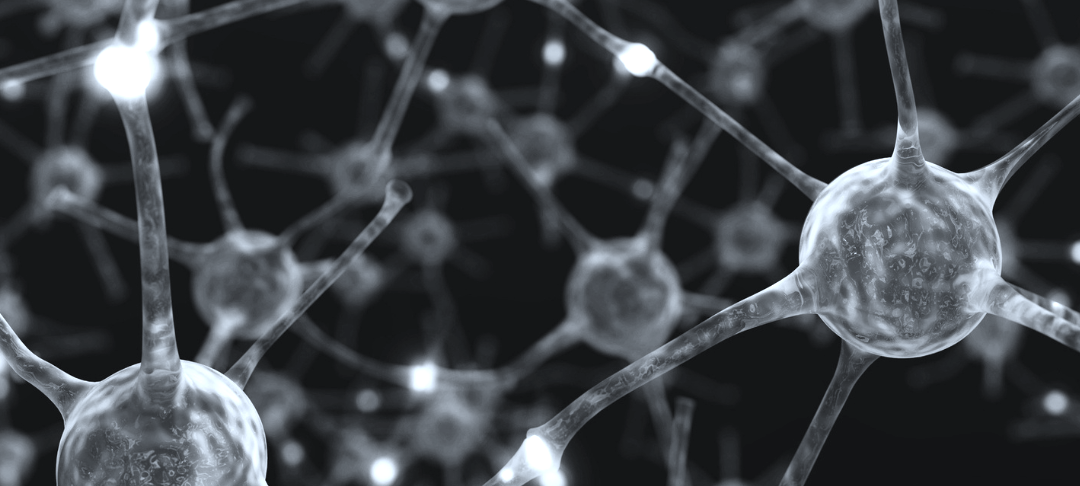
Hormones and neurotransmitters are part of the body’s communication system. They allow different organs and systems to exchange information and adapt to changing conditions. Although they are often mentioned together, they do not act in the same way.
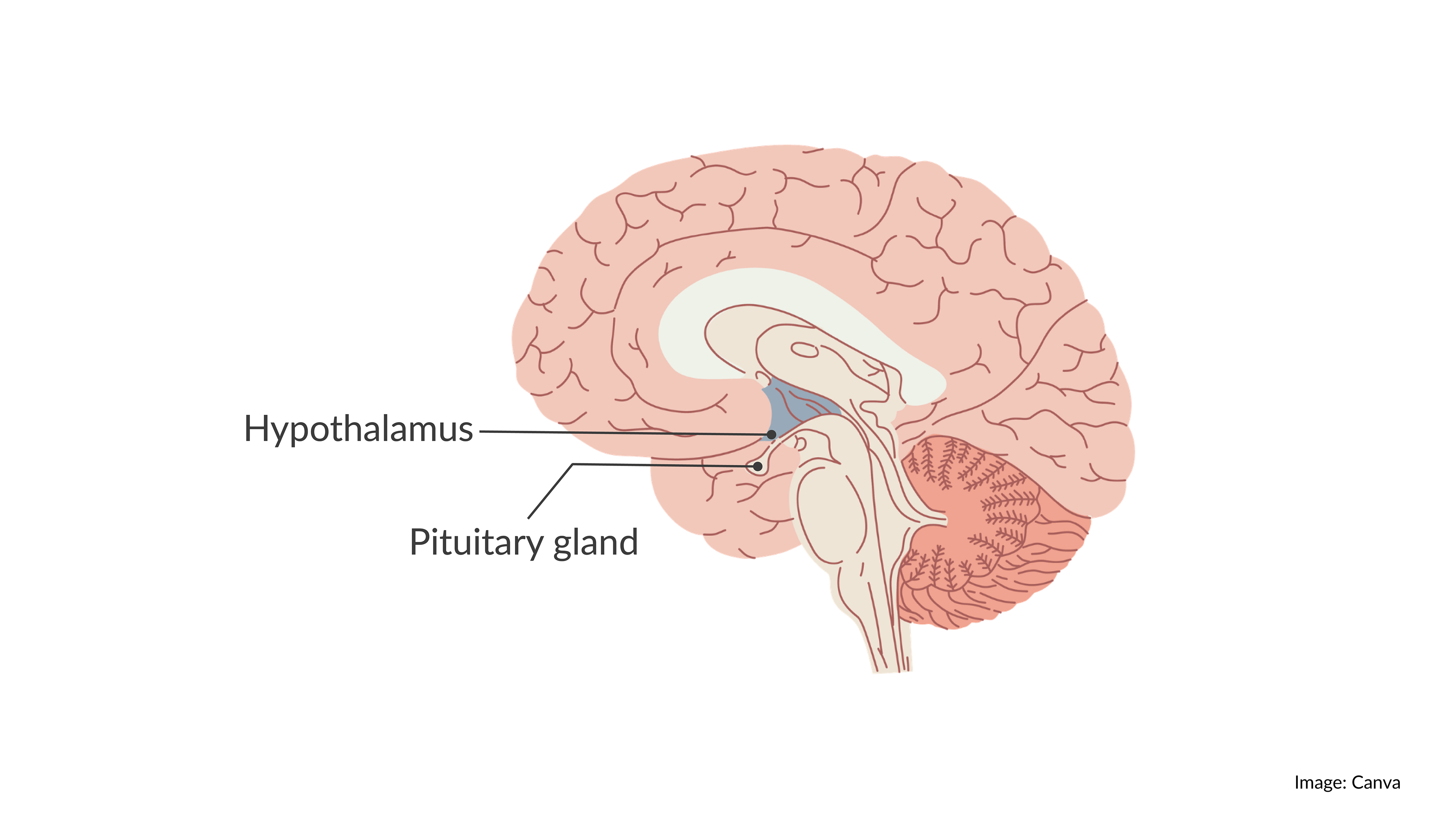
Central regions of the brain, including the hypothalamus (above) and the pituitary gland (below), play a key role in hormonal regulation. They coordinate signals and contribute to the overall balance of the body. Image Credit: K Bernhard-Novotny / Canva
In the body, neurotransmitters act at a local level. They are released by nerve cells and transmit signals from one neuron to another in a fraction of a second. This speed allows for immediate responses, for example in movement, perception, or reactions to the environment.
By contrast, hormones are released into body fluids and transported through the circulation to cells located at a distance. They bind to specific receptors on their target cells. Their effects take longer to develop than those of neurotransmitters, but they also last longer. They are involved in functions such as growth, reproduction, and the overall balance of the body.
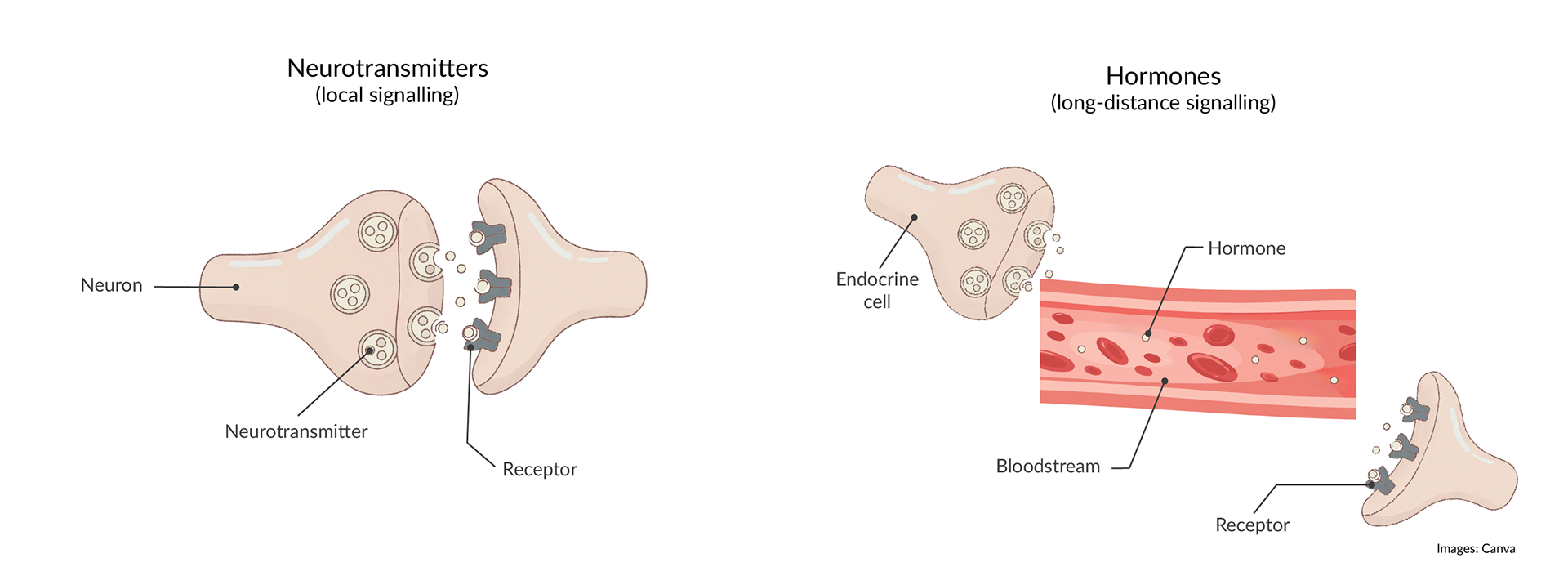
Two modes of chemical communication in the body. Neurotransmitters (left) act locally and allow rapid signaling between nerve cells. Hormones (right) are released into the bloodstream and act at a distance, with slower but longer-lasting effects. Image Credit: K Bernhard-Novotny / Canva
Some chemical messengers can act in both roles. Dopamine is one example. In the brain, it functions as a neurotransmitter involved in motivation and reward. In other contexts, it also plays a role in hormonal regulation. This overlap illustrates that the distinction between hormones and neurotransmitters is not always absolute, but relates more to how and where they act.
Several molecules are often highlighted in discussions about mood and well-being. Dopamine is associated with motivation and the sense of reward. Serotonin contributes to mood stability and emotional regulation. Oxytocin is involved in social bonding and attachment. Endorphins are linked to pain modulation and can produce a sense of relief or well-being.
These substances are sometimes presented in simplified ways, but their role is more complex. They do not act in isolation, and their effects depend on context, balance and interaction with other systems. Changes in their levels or activity can influence both physical and psychological states.
In medical practice, some treatments are designed to act on these signalling pathways. Certain medications enhance the effect of a chemical messenger, while others reduce or block it. This is the case, for example, in treatments that target mood disorders or hormonal imbalances. The aim is not to create a single effect, but to restore a more stable balance.
The body’s communication system does not rely on a single pathway. It is the result of multiple signals interacting at different speeds and levels. Understanding this helps to explain why symptoms can have several contributing factors, and why treatment often requires a tailored approach.
Sources: